Legionella Services: A Complete Guide to Staying Safe and Compliant
- craigtawc
- Dec 17, 2025
- 3 min read
Legionella services play a vital role in protecting people, properties, and businesses from the risks associated with Legionella bacteria. Any building with a water system — including offices, care homes, schools, rental properties, healthcare facilities, and industrial sites — has a legal duty to manage Legionella risk.
This complete guide explains what Legionella services are, why they are essential, what the law requires, and how professional Legionella management helps duty holders remain safe, compliant, and protected.
What Is Legionella and Why Is It Dangerous?
Legionella is a naturally occurring bacterium found in water systems. When conditions are right — particularly warm, stagnant water — the bacteria can multiply and become airborne through water droplets (aerosols).
Inhaling contaminated droplets can cause Legionnaires’ disease, a potentially fatal form of pneumonia. Those most at risk include:
Older adults
People with weakened immune systems
Smokers
Individuals with underlying health conditions
This makes effective Legionella control especially important in high-risk environments such as care homes, hospitals, hotels, and schools.
What Are Legionella Services?
Legionella services refer to a range of professional water safety activities designed to identify, control, and reduce the risk of Legionella bacteria in building water systems.
These services help duty holders comply with legal requirements under ACoP L8 and HSG274, while maintaining safe water systems for occupants and visitors.
Key Legionella Services Explained Legionella Risk Assessment
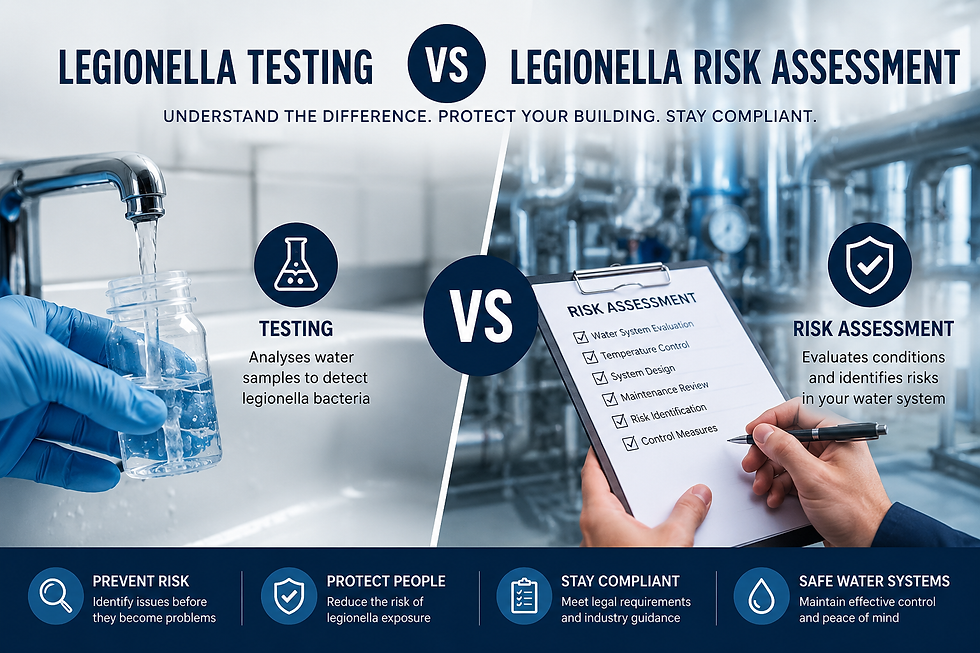
A Legionella risk assessment is the foundation of effective water safety management. It involves a detailed inspection of the water system to identify potential risks, including:
Stagnation and low-use outlets
Inadequate temperature control
Dead legs and redundant pipework
Poor system design or maintenance
High-risk users
The assessment produces a clear report outlining risk levels, required actions, and control measures, which the duty holder must implement.
Written Scheme of Control
A written scheme of control is a legal requirement under ACoP L8. It documents how Legionella risks are managed and includes:
Roles and responsibilities
Monitoring schedules
Control measures
Emergency procedures
Record-keeping requirements
This document ensures consistency and accountability in Legionella management.
Temperature Monitoring
Maintaining correct water temperatures is one of the most effective control methods:
Hot water stored at ≥60°C
Hot water delivered at ≥50°C (within 1 minute)
Cold water kept at ≤20°C
Routine temperature monitoring provides evidence of compliance and highlights problems before they become serious risks.
Water Sampling and Testing
Legionella water sampling may be required in higher-risk systems or where control measures are not performing as expected. Laboratory analysis confirms whether Legionella bacteria are present and at what levels.
Sampling should support — not replace — good system control and monitoring.
Flushing and Outlet Maintenance
Low-use outlets are a major contributor to stagnation. Legionella services often include:
Regular flushing regimes
Showerhead and tap descaling
Cleaning and disinfection of outlets
These tasks help prevent biofilm build-up and bacterial growth.
Water Tank Inspections and Cleaning
Cold water storage tanks should be inspected periodically for:
Sediment and debris
Inadequate insulation
Structural defects
Microbial contamination
Professional cleaning and refurbishment reduce contamination risk and improve system efficiency.
Who Needs Legionella Services?
Legionella services are required for a wide range of premises, including:
Commercial buildings and offices
Landlord-managed rental properties
Care homes and healthcare facilities
Schools, colleges, and universities
Hotels, gyms, and leisure centres
Industrial and manufacturing sites
If you control or manage a building with a water system, you are a duty holder with legal responsibilities.
Legal Requirements for Legionella Compliance
UK law requires duty holders to manage Legionella risks under:
Health and Safety at Work etc. Act 1974
ACoP L8 – Legionella: The Control of Legionella Bacteria in Water Systems
HSG274 (Parts 1–3)
Failure to comply can result in enforcement action, fines, reputational damage, and — in severe cases — prosecution.
How Often Should Legionella Services Be Carried Out?
The frequency of Legionella services depends on system complexity and risk level:
Risk assessments: typically every 1–2 years, or sooner if changes occur
Temperature monitoring: weekly to monthly
Flushing: weekly for low-use outlets
Tank inspections: annually (minimum)
Water sampling: risk-based
A competent Legionella specialist can define the correct schedule.
Why Choose a Professional Legionella Service Provider?
Legionella management requires competency, experience, and up-to-date knowledge. A professional provider ensures:
Compliance with current legislation
Accurate risk identification
Clear, actionable reporting
Ongoing support and advice
Reduced risk of outbreaks or enforcement
Using unqualified contractors places duty holders at significant legal risk.
Staying Safe and Compliant With Legionella Services
Effective Legionella services protect people, property, and businesses. By implementing professional risk assessments, monitoring, maintenance, and control measures, duty holders can confidently meet their legal obligations and maintain safe water systems.
Need Professional Legionella Services?
If you require Legionella risk assessments, monitoring, water sampling, or ongoing compliance support, working with a competent provider ensures your building remains safe and legally compliant.
Legionella services aren’t just about compliance, they’re about protecting lives.


Comments