Legionella Risk Assessments in Sheffield & Leeds — A Comprehensive UK Guide (2026)
- craigtawc
- Mar 11
- 4 min read
Legionella bacteria thrive in man‑made water systems when environmental conditions are right often between 20–45 °C with stagnant water and nutrient sources such as rust or biofilm. If people inhale contaminated water droplets, they can develop Legionnaires’ disease, a potentially severe form of pneumonia. UK law requires those in control of premises to identify and assess Legionella risk and take appropriate control measures.
In cities like Sheffield and Leeds, with ageing infrastructure, mixed commercial/residential buildings, and a variety of public facilities, conducting robust Legionella risk assessments has never been more essential.
What Is a Legionella Risk Assessment?
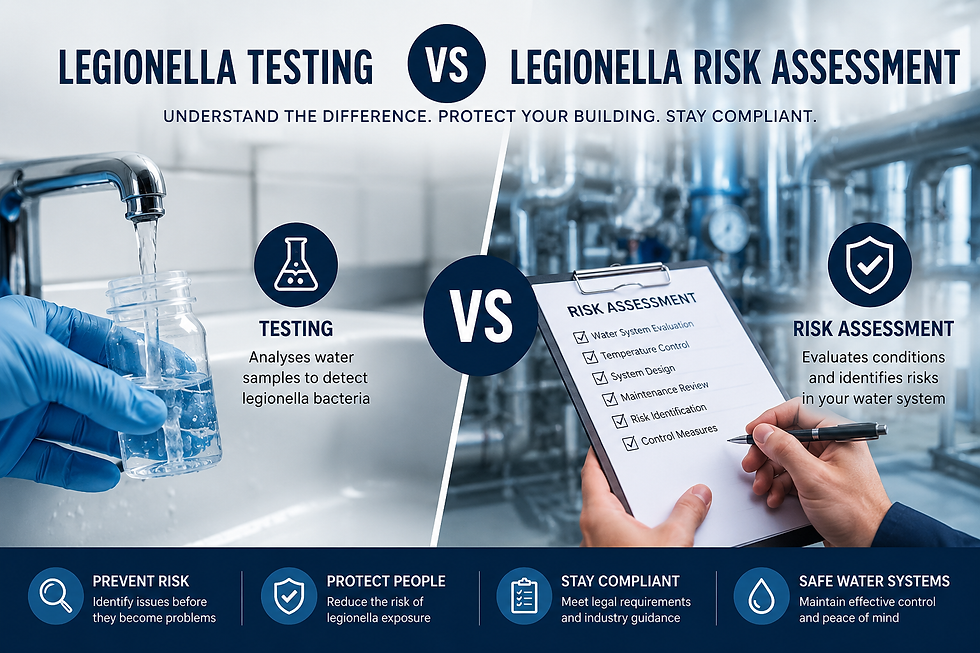
A Legionella risk assessment is a systematic review designed to:
Understand water system design and usage
Identify factors that could allow Legionella to proliferate
Evaluate exposure pathways (especially aerosolised water such as showers)
Recommend appropriate control measures
Document findings and assign responsibility
This isn’t a one‑off exercise but part of an ongoing management regime.
Who Needs One?
Under UK law (including the Health and Safety at Work Act 1974 and HSE’s ACoP L8 guidance), risk assessments should be carried out by:
Employers
Landlords
Facilities managers
Anyone in control of premises where water systems are present
This includes office buildings, retail premises, schools, hospitals, and large residential complexes all common in Sheffield and Leeds.
Sheffield & Leeds — Why Local Risk Assessments Matter
Sheffield’s mix of Victorian‑era housing, student accommodation, and older public facilities means landlords and building owners must pay close attention to water system design and maintenance.
Key considerations for buildings in Sheffield include:
Hot and cold water systems with stored water
Frequent shower and tap outlets especially in student blocks
Potential for stagnation in less‑used spaces (e.g., void flats or guest rooms)
A risk assessment helps uncover these conditions and propose mitigations such as flushing, temperature controls, or system redesign.
Leeds
Leeds City Council has an explicit Legionella policy that applies to council‑managed properties. It mandates suitable and sufficient risk assessments of all in‑scope water systems and the recording of significant findings.
The policy outlines:
Appointment of a Responsible Person for Legionella management
Classification of risk categories (higher vs. lower risk properties)
Regular monitoring — including temperature checks and flushing routines
Periodic Water Risk Assessment (WRA) reviews for high‑risk properties
For higher‑risk building archetypes (e.g., sheltered accommodation, high‑rise blocks), a full compliant WRA in line with BS 8580‑1:2019 and ACoP L8 is required and must be carried out by a competent assessor.
This structured approach makes Leeds one of the more advanced UK cities for Legionella governance.
Key Components of a Quality Risk Assessment
A comprehensive Legionella risk assessment typically includes:
1. System Analysis
A detailed description of plant and water systems — including tanks, pipework, showers, cooling systems, and storage — to identify potential growth areas.
2. Competency of Assessors
Assessments must be done by someone competent — trained, experienced, or supported by external specialists.
3. Risk Identification
Identifying conditions conducive to Legionella growth:
Water temperatures between 20–45 °C
Stagnant or rarely used outlets
Dead legs in pipework
Nutrient sources such as rust and biofilms
4. Control and Monitoring Measures
Every assessment should outline:
How water temperatures will be controlled
Flushing strategies for low‑use outlets
Disinfection routines
Regular monitoring and record‑keeping
5. Written Control Scheme
In line with HSE guidance, those responsible must maintain a written control scheme that details:
Who is responsible
What controls are in place
When and how checks are done
Results and remedial actions
How Often Should You Review a Risk Assessment?
UK guidance does not mandate a fixed schedule, but ACoP L8 recommends that risk assessments be reviewed when there is reason to belive the current one is no longer valid or two years as a minimum particularly if:
There are changes to the building or water system
Usage patterns change
A case of Legionnaires’ disease is linked to the system
The current controls appear ineffective
In higher‑risk buildings — such as hospitals, care homes, or student residence blocks — annual reviews are often appropriate.
Practical Steps for Landlords and Building Managers
Domestic and Residential Properties
For many Sheffield and Leeds landlords, a formal Water Risk Assessment should:
Assess stored water systems and rarely used outlets
Keep cold water at ≤20 °C and hot water ≥50 °C
Flush water regularly, especially after void periods
Even if full lab sampling isn’t required for domestic systems, the written assessment and control scheme are.
Commercial Premises & Larger Buildings
These properties often involve:
Cooling towers
Evaporative condensers
Complex plumbing
These systems — with aerosol generation potential — require more frequent testing and controls, often with quarterly sampling for cooling towers.
What are the Consequences of Non‑Compliance?
Failing to carry out proper risk assessments and implement controls can lead to:
Prosecution by the Health and Safety Executive
Significant corporate fines
Regulatory action from housing regulators
In the worst cases, criminal charges if negligence results in illness or death
Local firms in Leeds and the wider Yorkshire region now offer accredited Legionella risk assessments to support landlords and businesses in meeting these obligations.
A Proactive North England Approach
A Legionella risk assessment is not just a compliance exercise — it’s an essential element of ensuring water safety in Sheffield and Leeds. By understanding your water systems, identifying growth risks, implementing control measures, and reviewing your scheme regularly, you protect tenants, employees, and the public from a preventable disease. The regulatory environment in the UK — and specific policies like that in Leeds — supports a structured and accountable approach to water safety.


Comments