Legionella Risk Management in Kirklees: A Complete Guide for Duty Holders
- craigtawc
- Dec 15, 2025
- 3 min read
Legionella risk management is a critical legal and safety responsibility for duty holders across Kirklees. From historic mill buildings in Huddersfield and Dewsbury to modern healthcare facilities, schools, offices, and residential properties in Holmfirth, Batley, Mirfield, Cleckheaton and beyond, any building with a water system must actively manage the risk of Legionella bacteria.
With increased scrutiny from local authorities, the Health & Safety Executive (HSE), insurers, and enforcement bodies, Legionella compliance in Kirklees is no longer something that can be overlooked. This guide explains why Legionella poses a real risk in Kirklees properties, what the law requires, and how duty holders can ensure ongoing compliance.
Why Legionella Is a Serious Risk for Buildings Across Kirklees
Legionella bacteria thrive in stagnant or poorly controlled water systems — conditions commonly found in many Kirklees buildings due to age, layout, and usage patterns.
1. Ageing Pipework in Older Mills and Converted Buildings
Kirklees has a large number of heritage mills and repurposed industrial buildings, particularly in Huddersfield, Dewsbury and Batley. These properties often contain:
Outdated or oversized pipework
Redundant pipe runs and dead legs
Inadequate insulation
Poor water turnover
All of these factors significantly increase the risk of Legionella growth.
2. Long Pipe Runs in Rural Kirklees Locations
Villages such as Holmfirth, Meltham, Marsden, Denby Dale and Kirkburton often have long internal or external pipe runs. Maintaining hot and cold water temperatures across these distances can be challenging, making effective Legionella temperature control more difficult.
3. Mixed-Use and Low-Occupancy Commercial Premises
Commercial estates and industrial units in Cleckheaton, Heckmondwike and Mirfield frequently experience:
Variable occupancy
Seasonal or intermittent use
Weekend shutdowns
Low-use outlets
These conditions encourage stagnation — one of the biggest contributors to Legionella risk.
4. Higher-Risk Environments
Care homes, GP surgeries, dental practices, schools, hotels, gyms and leisure centres across Kirklees require stricter Legionella control measures due to vulnerable users and higher exposure risks.
Legal Requirements for Legionella Compliance in Kirklees
Under ACoP L8 and HSG274, every employer, landlord or person in control of premises (the duty holder) must:
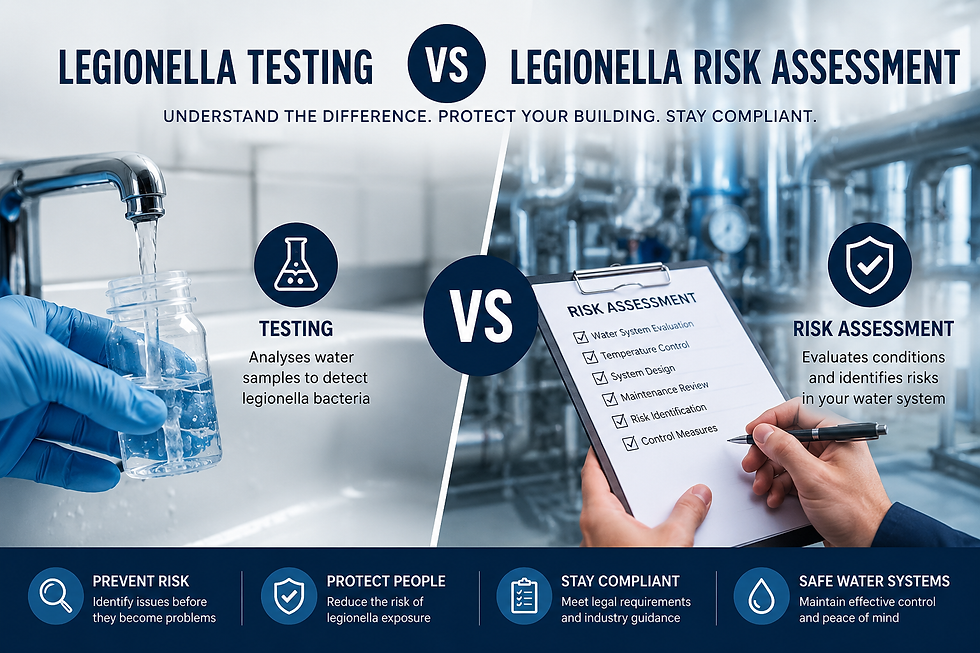
Carry out a Legionella risk assessment
Review the assessment regularly
Keep hot and cold water at safe temperatures
Implement a written scheme of control
Appoint competent persons to manage water systems
Carry out routine monitoring and inspections
Keep detailed records of checks and corrective actions
These requirements apply to commercial buildings, rental properties, public buildings and high-risk residential settings. Legionella compliance is a legal obligation, not a recommendation.
How Often Should a Legionella Risk Assessment Be Reviewed?
One of the most common questions we receive from duty holders across Kirklees is:
“How often do I need to review my Legionella risk assessment?”
ACoP L8 requires assessments to be reviewed regularly, with the frequency determined by the level of risk. A review is mandatory when:
The water system is altered or extended
Building use or occupancy changes
There are prolonged shutdowns (e.g. school holidays)
Monitoring results indicate control failures
There is reason to believe the assessment is no longer valid
For most Kirklees premises, reviews are typically required every 1–2 years, although care homes, healthcare settings and complex systems may need more frequent reassessment.
Common Legionella Issues Found in Kirklees Properties
Across HD1–HD9 and WF12–WF17 postcode areas, our Legionella consultants repeatedly identify the same issues:
Cold water failing to achieve ≤20°C
Low-use outlets causing stagnation
Outdated or ineffective written schemes
Hidden dead legs from historic refurbishments
Poorly insulated pipework and storage tanks
Missing asset registers or system schematics
Water storage tanks requiring cleaning or refurbishment
Early identification through a professional Legionella risk assessment in Kirklees helps prevent enforcement action, system failure, and costly remedial work.
Why Using a Competent Legionella Specialist Is Essential
Competency is a legal requirement under ACoP L8. Using unqualified assessors puts duty holders at risk of non-compliance and enforcement action.
At Absolute Water Compliance, all consultants are City & Guilds qualified and experienced in assessing a wide range of Kirklees properties.
Our Legionella Services Include:
Legionella risk assessments
Routine temperature monitoring
Water sampling and analysis
Flushing regimes and outlet cleaning
Showerhead descaling
Written scheme creation and review
Full system inspections
Ongoing Legionella compliance support
Every report includes a detailed schematic drawing and asset register, giving duty holders clear, actionable guidance.
Legionella Risk Assessment Services Across Kirklees
We support duty holders throughout Kirklees, including:
Huddersfield • Dewsbury • Holmfirth • Batley • Mirfield • Cleckheaton • Heckmondwike • Marsden • Slaithwaite • Skelmanthorpe • Denby Dale • Kirkburton • Meltham
…and all HD and WF postcodes within the Kirklees borough.
Need Help With Legionella Compliance in Kirklees?
If you are responsible for a building in Kirklees and require a Legionella risk assessment, review, or ongoing water safety support, our team is ready to help.
01226 491133
Absolute Water Compliance — supporting Kirklees duty holders with expert Legionella control, water safety compliance, and complete peace of mind.


Comments